
Vancouver Island is home to an abundance of wildlife and their related ecosystems. Some of these are now threatened due to urban advancement and habitat degradation. Some of the species at risk are as follows:
MARBLED MURRELET
(Brachyramphus marmoratus)
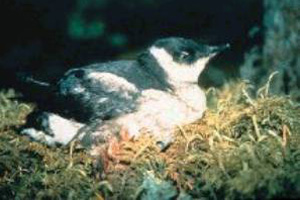 The marbled murrelet, a small seabird which nests in the coastal, old-growth forests of the Pacific Northwest, is listed as a threatened species under the Endangered Species Act. In North America, the birds’ range stretches along the Pacific coast from the Bering Sea to central California with the largest populations occurring in southeastern Alaska and northern British Columbia.
The murrelet’s dependence on old-growth nesting habitat and use of coastal marine feeding areas have brought it into frequent conflict with human economic interests, especially in the southern portion of its range where small, geographically concentrated populations are especially vulnerable to extirpation. However, both natural and human-related factors may be contributing to the species’ decline; potential causes include the loss of suitable nesting habitat, accidental death in gill-nets, oil pollution, increases in predator populations, and declines in food supplies due to recent El Nino events.
 The Marbled Murrelet could easily lay claim to the title “most mysterious bird on the Pacific coast of Canada.” It nests on the mainland in almost total obscurity, although people who fish and boat along the British Columbia coast during spring and summer (when the birds are nesting) often see Marbled Murrelets out on the water. Amazingly, in the 200 years that the species has been known to science, observers in British Columbia have seen only one occupied nest, in 1990. The story is the same over the whole of the murrelet’s North Pacific range (see map). To date, there are just over a dozen recorded sightings of occupied nests from Canada, Japan, Russia, and the United States.
PURPLE MARTINS
(Progne subis)
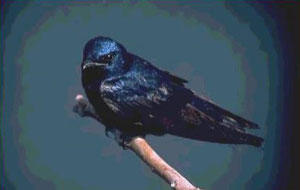 The Purple Martin is a conspicuous bird in many populated areas of North America during spring and summer.
Averaging 17 to 20 cm in length, it is Canada’s largest swallow. The Purple Martin resembles other swallows in having a slender body, long wings, and a wide beak. The tail is forked but not deeply as in some other swallows. Male martins, with their dark plumage, often appear to be black, but on bright sunny days their shiny blue-black coloration is clearly visible. Female martins are lighter in colour, with a pale grey throat and belly. By the time they have left the nest, young martins of both sexes resemble adult females. Young males only become dark at their second breeding season.
The Purple Martin breeds throughout much of southern Canada, including Nova Scotia, the southern portions of New Brunswick, Quebec, Ontario, and Manitoba; southern and central Saskatchewan; and north-central Alberta. In British Columbia, martins are found in the Peace River region, southern Vancouver Island, and the extreme southwestern mainland. Martins are much less common in western Canada than in the eastern provinces.
 Martins arrive in Canada in early spring, usually in early April in Quebec and Ontario and from late April to early May in other areas.
Martins have been banded, or tracked by placing a numbered aluminum band around the leg, for many years. Recoveries of banded martins have provided extensive information about the movement of these long-distance migrants. Of the adult birds banded and sighted again, most had returned to the breeding colonies where they were banded or to one near by. Banded nestlings have also typically returned to their home colonies to breed, although a few young bred hundreds of kilometers from their birthplace. Banding has also provided information on the lifespan of martins. Most martins live to four or five years. The oldest martin on record is an eight-year-old recaptured at its breeding colony.
The ability of martins to find their colony is remarkable. In one experiment, adults that were transported several hundred kilometers from their nesting colonies returned in a matter of days.
SHARP TAILED SNAKE
(Contia tenuis)
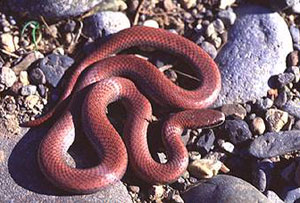 This is a small, slender snake 20-45 cm from snout to vent. It is coppery or reddish on the back, with darker sides. The belly is whitish with a half-moon shaped crossbar on each scale. The tail is tipped with a small spine. A variety of habitats are used by this snake ranging from Garry oak grasslands to forest. It is usually found near water or in clearings near forests. When the soil is damp it spends much of time under rocks or logs, but when the soil dries out it will retreat underground.
Sharp-tailed snakes are rare, and seem to occur in widely scattered populations. They are most active on the surface in early spring and again in late fall. They eat primarily small slugs, and have special long teeth for biting them. It is a Red-listed species in BC and confirmed occurrences of sharp-railed snakes have been recorded at only seven locations in BC, all on southern Vancouver Island and the Gulf Islands. These snakes are very secretive and hard to find, making population sized difficult to estimate.
In BC, sharp-tailed snakes are at the northern extremity of their range, and it is unlikely they were ever abundant.
Conservation efforts have recommended private landowners avoid using pesticides and chemical slug-bait, and try to maintain natural area with protective cover in your yard.
COMMON RINGLET
(Coenonympha california insulana)
 The common ringlet’s wing colour ranges from dark orange-brown to pale cream with the underside of the forewing usually having a small eyespot near its tip. The underside of hindwing is gray-green with a wavy white median line and has a total wing span of 1 1/3 – 1 1/2 inches (3.4 – 3.8 cm) and they have a characteristic bouncing flight pattern.
This butterfly is extremely variable geographically, with at least 4 subspecies. They may be found in suitable habitats in the Pacific Northwest from southwestern BC to Oregon, including the San Juan Islands and Garry oak ecosystems. In the 1950’s this subspecies was one of the most abundant butterflies on Vancouver Island, but it is now rare and has been Red-listed in BC.
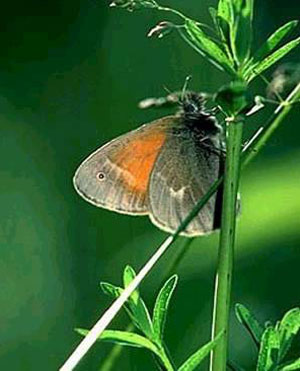 Butterfly populations are very closely linked to the availability of larval and adult foodplants. The common ringlet larva require green native grasses as food and may also feed on sedges. Suitable habitats include open areas with short grass, in locations that have sufficient moisture for the vegetation to stay green throughout the dry summer without being subject to flooding in winter.
Protection of suitable habitat and food sources may help reduce the decline of this species. Removal of invasive shrubs such as Scotch broom and the reintroduction of native grasses will help this butterfly as well as many other native species that depend on similar habitats.
LEWIS’S WOODPECKER
(Melanerpes lewis)
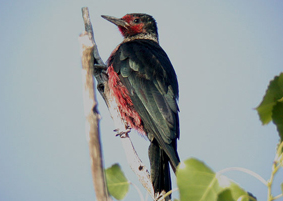
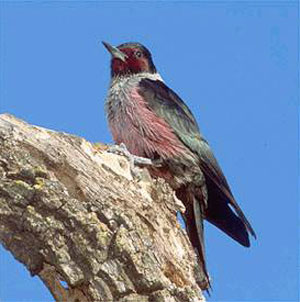 Adult Lewis’s Woodpeckers have a medium sized head, short neck, and large body. The bill and feet are dusky blue-gray. The back of this species is black, glossed with green, and the belly is rose red. There is a deep red band which runs across the forehead and throat, extending behind and below the eye. The throat and wings are black with a band of dull white over the hind neck extending forward and around the breast. The adult female resembles the male, although she is slightly duller in color with less red on the front of the head. The wings are long, spanning to 21 inches. The tail is of medium length and very strong. It has ten feathers that are pointed and stiff. The outside feathers are shorter than the center ones.
This woodpecker’s diet varies with the seasonal abundance of food items; primarily free-living (not wood-boring) insects older than larval stage, principally ants, bees, and wasps, beetles, and grasshoppers; acorns or other nuts, and fruit.
Vocalizations:
Drum: Drum is short, weak, and at medium speed followed by several individual taps.
Calls: A series of short, harsh chr notes. The “contact call” is a weak, sneezy teef or kitsif; also a high, squeaky, descending rik rik rik. Dry, rattling chase series reminiscent of European Starling.
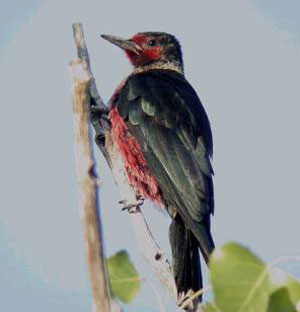 It’s three principal habitats are open ponderosa pine forest, open riparian woodland dominated by cottonwood, and logged or burned pine forest; however breeding birds are also found in oak woodland, nut and fruit orchards, pinyon pine-juniper woodland, a variety of pine and fir forests, and agricultural areas including farm and ranchland. Important aspects of breeding habitat include an open canopy, a brushy understory offering ground cover and abundant insects, dead or downed woody material, available perches, and abundant insects.
The Lewis’ Woodpecker is of high conservation importance, because of its relatively small and patchy distribution, low overall density, and association with mature montane and riparian forests. This species is poorly monitored in many parts of its range, but exhibits a significant long-term decline overall. Populations may have declined by as much as 50 % since 1966. Associations with various forest types, sensitivity to fragmentation and silvicultural practices are poorly known and will be important to understand for sustaining healthy populations.
The Georgia Depression population of Lewis’s woodpeckers is red-listed in BC, presumed extirpated. Current occurrences of this species here are restricted to occasional appearances of single birds on southeastern Vancouver Island and in the lower Fraser River Valley. This extirpation occurred at the same time as range-wide population declines. Habitat loss and degradation are thought to be primary factors, with urban development, fire suppression, and removal of dead and dying trees being the greatest sources of reduced habitat sustainability.
Patches of suitable habitat still exists on Vancouver Island, and general measures to restore and protect these area may eventually permit natural or human assisted re-introduction. Nesting habitat will be maintained and increased by the retention of dead and declining tress and ‘planting’ of artificial snags. Such habitat enhancement would be of greatest benefit in concert with management of European starling populations. Steps should also be taken to control local pesticide use that negatively affects population of flying insects.
PROPERTIUS DUSKYWING
(Erynnis propertius)
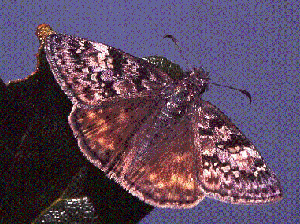 The Duskywing’s Upperside is predominantly brown; forewings with gray overscaling and distinct dark markings. Clear spots are small in the male, large in the female. The underside of the hindwing has well-defined spots below the apex. Wing span: 1 3/8 – 1 3/4 inches (3.5 – 4.5 cm).
Their preferred habitat is open oak woodlands, forest openings and edges, meadows and fields near oaks from sea level to middle elevations. Does not occur in deserts or hot central valleys. They range in southern British Columbia south along the Pacific Slope to Baja California Norte.
Duskywing’s generally have only one generation per year, although there may occasionally be a second brood. Adults are most commonly seen on the wing in April and May.
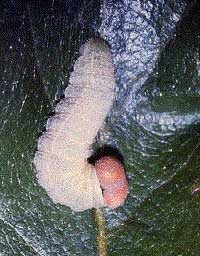 Propertius duskywings are red listed in BC and are disappearing along with Garry oak habitats, especially in rapidly urbanizing area. These duskywings disappear from urban area even where Garry oak trees are left standing, perhaps because of pesticide use and in part because of the “cleaning up” of leaf litter containing overwintering pupae.
The best suggested way to preserve this species is to protect large area of Garry oak woodland and keep them clear of invasive species such as Scotch broom and non-native grasses. Leaf litter should be left around the base of Garry oak trees for overwintering larvae, and surrounding grasslands left in a natural state. Avoid the use of pesticides.
STREAKED HORNED LARK
(Eremophila alpestris strigata)
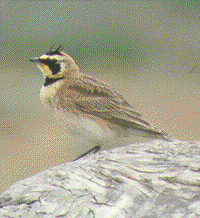 The Streaked Horned Lark is a small, ground-dwelling songbird with conspicuous feather tufts, or “horns,” on its head. Its back is heavily streaked with black, contrasting sharply with its deeply ruddy brown nape and yellow underparts. The male is distinctively marked with a dark facial mask and breastband that contrasts with the pale face and throat.
The historical range of streaked horned larks was confined to the coastal plain of south western BC, Washington and Oregon. Populations in BC were likely never numerous, and this subspecies is virtually extirpated from Vancouver Island (one territorial male was seen during the 2002 breeding season).
Breeding occurs from early April to August, and nests are built in a hollow in the ground, often beside a clump of dirt or tuft of grass. These larks are most often found in are areas with bare ground, including spits, estuaries, sand dunes and Garry oak meadows, as well as some modified areas such as pastures, playing fields, airports and roadsides.